Thursday, July 19, 2012

What it takes to make us pack it just in a little early

Please understand that by "a little early," understand that I mean it was a 9 hour day instead of 11 or 12.


Understand, we'd have kept working if it was just light rain. Hell, moderate rain we'd have probably pushed through, despite problems seeing the screens on our dataloggers, and other equipment. That's just how we roll. We're what the kids call "hardcore" these days.

But hail, plus lightning on our adjacent hillsides, really got us jamming back toward the truck.

Wednesday, July 18, 2012

Urban Forestry

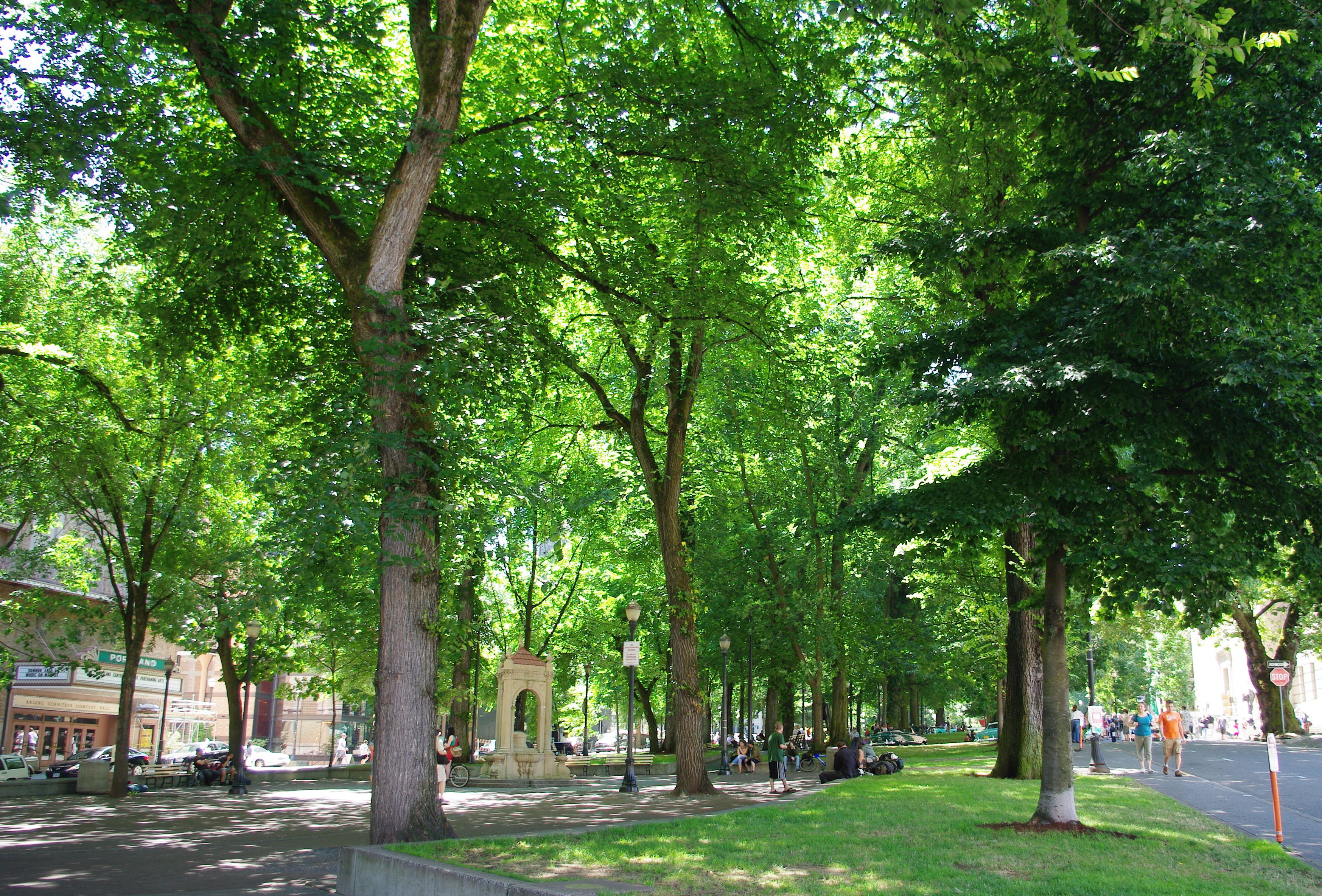
I just wanted to share with you all an article I read recently about Portland's urban forestry, in the South Park Blocks in particular. For those of you who don't know, the South Park Blocks are a. 8.76 acre, 12-block long stretch of trees with a playground, fountains, and historical statues, a space that's been there since 1848 when it was first platted on the then-outskirts of town. It has since been absorbed into the southern reaches of what's now Downtown Portland, and is adjacent to the Portland State campus. It's part of what makes Portland so nice, liveable, welcoming. Walk there any time of year and you'll feel the history of the place in the shade of the trees, the age of the buildings alongside it. The North Park Blocks, home to the City's first playground since 1908, are just as nice in their way, but at a piddling 3.11 acres and with smaller trees, so you get a nicer walk in the South.

Lovely spot at Salmon Street

So it seems the trees in the South Park Blocks are getting too old and tall. One of them fell recently, so they're going to go about cutting some of the older ones down and replanting some youngsters. Naturally, this has to be done. Nobody wants pedestrians getting hurt (any more than they already have), buildings getting damaged, etc. Makes me sad and glad at the same time. Sad for the loss of incredible trees that have seen so much change around them, glad for the planning and hard work that will go into maintaining and managing the trees that people here care about so much. That's my tax dollars at work, people, and I wouldn't have it any other way. 

Quoth the article:
 As old trees disappear, so will the soaring canopies that distinguish many Portland parks and neighborhoods. It will be a shocking change for a city that boasts stands of stately elms and towering firs. Ensuring a green canopy for Portland's future requires a more varied urban forest, with many sizes and species replacing the towering trees people have come to love.

Eleven of the oldest trees have been tagged for removal, and some have already been taken down. At over a century in age, these trees have had a good life and provided plenty of shade and enjoyment to the residents of Portland, so their time has come. Fair enough. If you're interested, though there are changes coming to the City's urban forestry planning and management, here's a link to the 2004 Urban Forestry Master Plan for the City of Portland. With over 10,000 acres of parks, Portland has a lot to do!

But reading the article brought to mind how much I love Portland's canopy, open spaces, and the overall impression of verdant life bursting from all corners that the place has about it, and I wanted to share just a couple photos from a recent walk I took with my wife. These are from in or around Laurelhurst Park, not too far from our home. These were taken at something like 8pm or later, which shows how a lovely summer afternoon can just smear itself into evening hours in Portland.

The breathtaking view isn't helping this cyclist catch his breath, is it?

One of the more charming features of Laurelhurst Park is these lamps they have along the pathways. My wife likes to imagine she's peering out of the back end of an antique wardrobe whenever she takes pictures of these. Take a look at this shot, and try to recapture the awe of reading the first book that truly captivated you as a child . . . imagine yourself discovering Narnia for just a moment.

Mr. Tumnus sends his regards.

I am so in love with my hometown. Beautiful moments like this one are encountered on a daily basis, if you bother to look around. I'm sure that's true of other places as well, but mine's special, and uniquely well suited to me.

 How can you NOT love this?

Thanks for reading, all. Hope I made you smile, maybe made you want to visit. Please leave a comment, tell me about your favorite places, your favorite parts of Portland, or your thoughts on Urban Forestry.

Much love!

Tuesday, July 3, 2012

Logging Roads

So, you all know logging is a big deal, but did you know logging roads themselves have an impact? I know this may seem a kinda esoteric topic, but it's serious enough that there's a case about to come to the Supreme Court about it. Keep reading, and you'll have some idea what's up.

Logging roads tend to be places where erosion can occur, because they weren't always placed carefully, their existence resulted in the removal of a lot of trees that had stabilized hillsides and filtered water that later made its way to streams, and their purpose did not involve a lot of foresight beyond getting at lumber. A lot of the time, roadbuilders would divert a stream from its natural course to make sure it couldn't interfere with the road. In addition, logging truck traffic can grind gravels into a fine sediment that then washes into streams and rivers, which, if you've been reading, you know is bad for salmon spawning and for a lot of other species in the streams.

In the Grande Ronde Basin where I've been working, the Mount Emily Logging Company, the main logging company in the area for a long time, started shifting from using railroads to trucking on logging roads in the 1930's (though they were still investing in new railroad extensions as late as 1944 to get at a neighboring basin's trees). Roadbuilding really picked up in the 1950's when the Forest Service started "salvage logging" operations. More on that another time, perhaps. For now, know that roadbuilding more than doubled in the years between 1978 and 1989, and the current road density is something like 2.5 km of road for every square kilometer in the Grande Ronde basin. Huge.

That's why it really warms my heart when I see something like this on an old road that winds up to the headwaters of a beautiful stream:

YOU SHALL NOT PASS!

Love it. They closed off the road and did restoration work all up and down what remains above this barrier. There's even a fence to keep out more limber ATVs and the like. I didn't follow the restoration all the way up, but they've thrown down large lumber as further roadblocks (and erosion controls) and put in a ton of new tree plantings for at least a kilometer up from this roadblock.

 This shot shows a little of the scope of the restoration effort for just this one road. I wish I knew who did it so I could thank them. I got to hike along this quite a ways to get to one of our monitoring sites, and it ran along a stream the whole way. This work represents a lot of improvement in habitat, for upland creatures as well as in-stream ones.

All those little bits of fencing there? Those are there to protect the baby plantings. See, when saplings come up naturally, they don't tend to form what looks like a buffet line for deer, elk, cattle, or any other herbivores that wander through. So in restoration work, you have to have fencing to keep the leaf-munchers away until the plant is strong enough to survive a little nibble now and then. These fences should do the trick. If you ever volunteer for this kind of work, you may run into some boyscouts chasing badges by showing up with massive rolls of the stuff, posts, and some wirecutters to construct these things out of, as I did a while back at the Ridgefield National Wildlife Refuge.

But it goes further. Another thing that naturally dispersed seedlings have in the kind of habitat the restoration workers were trying to recreate/reinforce here is shade. These babies grow surrounded and shaded by their elders, not out in the open like this. So, I kid you not, each and every one of these plantings, along a long stretch of former road, has a protective  fence AND a little shade screen next to it so it doesn't get a fatal sunburn. This is, after all, EASTERN Oregon, not Portland. They actually get sun out there, unlike here at home, where summer has yet to arrive in July.

And yes, because I know that this immediately jumps to mind for all of you, yes, all of that hay you see there was thrown down for short-term erosion control and yes, it is actually certified as weed-free. I know this because there are literally road signs every mile or three through the forest proclaiming that all hay on Forest Service lands has to be. This is a necessary and valuable precaution that ensures that not only baby plantings like this, but also full grown forest stands don't get choked out by invasive plants like Himalayan Blackberry (tasty, tasty evil, that one), or English Ivy.

For some additional background on the Grande Ronde Basin's history, you can go here, and if you'd like a more academic overview of land use practices in the area, this paper is great. Yes, I already linked to them both above, but you didn't click over because you were so engaged by my writing, correct?

Enjoy!

Wednesday, June 27, 2012

Humdrum labor

Ladies and gentlemen, this is the part where I tell you all about my boring, soulless toil. In this entry, you'll get to see some very mundane tools and read all about the pointless busywork we use them for, as well as the lethargy I fight to get through the day. And really, I gotta say, my workplace is the worst part. Check out the break room.

Do YOU see a coffee machine?

Ok it isn't all that bad. Fact is, I get to do important work that I feel good about, and it really is fascinating and entertaining on multiple levels. The people are great, the scenery is spectacular, and I have a lot of fun tromping through forests and streams all day. Yeah, you come home exhausted after 12 hours of this, but however hard you work, however tedious some of the tasks are, can you really have a bad day in that kind of setting? I don't think so. Maybe this is just my perspective as someone who spent an unfortunate amount of time in a cubicle under fluorescent lighting, and maybe it'll wear off after I've done a whole season of this work, but I just really enjoy getting paid to go hiking.

Ok, time to get down to brass tacks. Let me tell you about some of the tools we use, and why. The very first thing we did in the field was retrieve temperature loggers that have been in the streams we're monitoring for about a year now, download their data, and redeploy them.

 That's me, waist deep in rushing water, holding up the housing and weights that were chained to the roots of a streamside tree, about to pull the logger from the housing. So the reason stream temperatures are important is because there's a range within which salmon eggs and young can thrive, and there are lots of temperatures where they don't do so well. One element of the habitat monitoring project, naturally, is to track temperatures.

To secure the loggers in place, we can cable them to a stable structure like a tree root, epoxy them underwater to the side of a boulder that looks unlikely to move, or drive a thick metal stake into the ground (often through cobbles the size of my fist) and chain it to that. These loggers need to be weighed down so they stay in the water year round (keep in mind that water levels fluctuate dramatically over a year), and need to have a cable and housing strong enough to withstand the beating delivered by all the boulders and cobbles that roll downstream throughout the year.

Yes, we lost a few. Sometimes you find a frayed bit of cable, sometimes you find nothing. I was talented enough to actually lose one after I'd retrieved it. I was fiddling with the housing, trying to get the logger out, and it just slipped. Three grown men chased this tiny floating piece of electronic equipment, about the size of my thumb, through waist deep water, struggling not to trip and top our waders. It was downright comical. We lost it, though, as it entered a mess of debris on the bank and we couldn't find it after that. Later, I did top my waders just trying to get across the stream, and we also found the second dead baby deer facedown in the water in two days; the site was thereafter known as "Pablo's Lament."

Another favorite tool of the trade: the viewing scope. This is basically a big PVC tube with a clear plastic lid on one end, which you use to check out the rocks, pebbles, and sand under your feet in the water. This tool is needed because when salmon lay their eggs, they need to do it in a place with larger gravel or cobbles that water can still flow through. The eggs grow and mature in the spaces between the rocks, sheltered from predators, and oxygenated by the constant flow of the water. If there's too much sand or silt or clay or mud, the eggs choke out and don't make it. So in order to tell if a stream is good spawning habitat for salmon, we need to be able to examine the substrate and see if eggs would survive there. Unfortunately the device is impossible to use in a dignified manner, as you spend a lot of time getting your bum photographed by coworkers with an inappropriate sense of humor (that is, me).

Say "Hi," Seth!

Anyway, more to come soon. I wanna tell you all about the other exciting tools we use. There's a whole bunch more, like the "sun eye," a camera with a fish-eye lens that we use to measure how much direct sunlight a stream gets through the year, the ever-useful stick-with-a-ruler-on-it, and the whole pile of surveying equipment you saw in use in the video from my last post. 

I hope this entertained and enlightened, at least a little. Please leave comments and tell me your thoughts, ask questions, or hurl invectives. How else will I know I'm loved?

Sunday, June 24, 2012

Introduction

Hello, all!

For any who don't know, I'm Pablo. I have a Bachelors in Applied Ecology from UC Irvine, and a Graduate Certificate in Fisheries Management from Oregon State University. I have worked for consulting firms and governmental agencies, as an ecologist and a hazardous waste technician, in California and in Oregon. I am a husband to one brilliant woman, father of two wacky kids, and housemate to many interesting people.

I don't know if this site will be anything more than a diary of sorts, or if, you know, people will actually read what I put up here, but I'm writing because I feel like it. I know there's no shortage of environmentalist blogs out there, and no shortage of outdoorsy blogs, and there is far better science writing out there than I could ever hope to match, but I think I may have something worthwhile to contribute to each of those sub-genres. I expect to occasionally use this space to record random thoughts that occur to me in the course of my work and my outdoor excursions, and occasionally to write about scientific publications that catch my eye. If I'm lucky, I may actually get to interview a few people about their work.

I am currently working for the Columbia River Inter-tribal Fish Commission on the Columbia Habitat Monitoring Program (happily known as CHaMP), which seeks to implement a standardized monitoring protocol across 26 watersheds of the Columbia River Basin in order to evaluate the quantity and quality of tributary fish habitat available to salmonids across the Columbia River basin, not to mention changes over time. It goes without saying that this is an incredibly cool project with long-term implications, and I feel incredibly lucky to be a part of it. Here's a little video the CHaMP folks put together:


My whole upcoming summer is gonna be wading in gorgeous streams in eastern Oregon, measuring every possible parameter of fish habitat, and hanging out with my crew. After that, I get to spend another season and a half post-processing all that data. I hope to coherently explain the how and why of some of what I do, the hands-on aspect of it, and the bigger picture of the effort. I may even talk a little about my time at the field house with coworkers, tell you a bit about their interests and pursuits.

This space will be under construction as things change and grow, so come back often. The more visits I get, the more I'll be encouraged, tempted, cajoled, enticed to write. Please do let me know what you think as things progress.