Wednesday, December 5, 2012

Gills

Simple question: What do you think of when you think of gills? Probably, the image you get is that flap of hard, cartilaginous flesh right behind the mouth of a fish, am I right?

That's what I thought, too, as a kid. But I was wrong. The gills are actually the tissues behind that flap, and that flap is just a protective cover known as the operculum, which sorta helps control the rate of flow over the gills, thus matching the gas exchange rate to the fish's metabolic need. And another thing I didn't know about gills as a kid: non-fish creatures have gills, too!

Oh, I suppose I knew that bugs and other non-fish creatures in the water had to breathe somehow, but even with this knowledge, the gills I picture in my head are that flap of moving flesh, like Kevin Costner's neck in Water World, not the bloody, fibrous stuff underneath. The thing on the outside of a fish's head looks like it's helping the fish breathe water, right? Well, can you spot the gills on this little guy?


Tiny Dancer

Does that look like breathing? 50 points if you guessed that this bug's gills are the "hairy" growths in the many armpits and joints on the little guy's underside. 50 more points if you can tell whether this is a stonefly, caddisfly, or mayfly. So yeah, that little jig he was dancing is him breathing. He's in a little display case, so the water stagnates a bit, and he has to shuffle side to side like that to get enough water passing over his gills. In his stream the water flows over him pretty consistently, and he can just walk to wherever is more comfortable, but not here. Don't worry, we returned him to his proper habitat not long after I took the video.

Gills are just the water-life equivalent of the alveoli in our lungs. They're extremely delicate, blood-rich tissues that allow for gas exchange with the surrounding environment. Blood gets brought so close to the outside surfaces of the tissues that Oxygen gets taken into the blood, Carbon Dioxide gets pushed out, and the blood just keeps moving right on through, refreshed for another go-round through the whole body. There's a great graphic and short explanation of how it works at this site here, if you're interested.

Can you imagine your breathing apparatus being practically outside your body? The sensitivity of these structures is incredible. In order to function properly, they need to be in the environment they're adapted for. This means the pH of the water (how acidic it is or isn't), how much bacteria and algae are in the water, how much mud or silt is suspended in the water, all have to be juuuust right in order for aquatic creatures to breathe. All these factors, even the amount of dissolved Oxygen that exists in the water, the excess that's floating about for the fish to breathe, can fluctuate dramatically based on temperature, which is why one of the biggest problem contaminants we introduce into streams is actually just heat. After a factory draws water from a stream, uses it, and discharges it back into the stream, even if they clean it perfectly and there's no contaminants or traces of their process left, it can still be a big problem for aquatic life if it gets returned 10 degrees warmer than it got taken out. More on stream temperatures in another post, another time.  

Ok, so fish gills are under the operculum, fairly well protected, but what about a breathing apparatus ENTIRELY outside the body? Is it just bugs like our friend above? Nope. When I first started working with the Endangered California Tiger Salamander (CTS) in various regions of California, I was really surprised at what their larval form's gills looked like. A little background: They breed and are born in water, but spend most of their lives hiding in small mammal burrows. While they're still young, before they leave the vernal pools they hatched in, they still have gills. External gills, which I'd never really seen before.

I don't have copyright permission for any of my favorite photos of this, so here's a short description, followed by a couple links to some really nice shots, and I DID find a photo attached to a public newspaper article, so I think I can use that at the bottom. Picture a tadpole, but leggier; this salamander has all four legs for its whole life cycle, but while it lives in the water it also has a tadpole-like tail coming off of much of its body. Now add six little trees that sprout from the back of its head, three on either side. The trunk of that tree is structural support for all the feathery tissues (leaves?) that do the gas exchange, the gills. Now, go check out these three shots, taken by a very talented photographer and archived on the California Herps website . . . isn't that adorable?
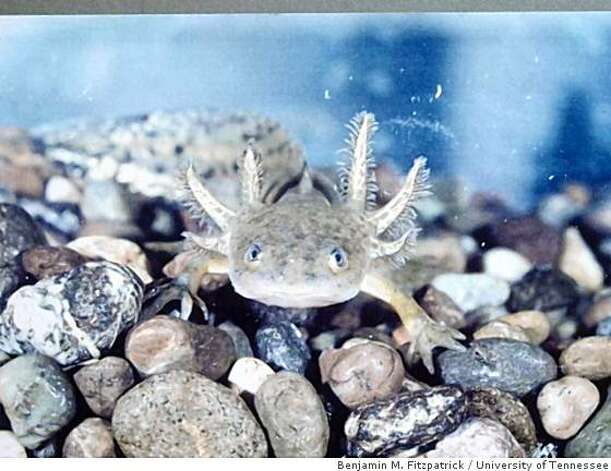
Totally not what you think of when someone says "gills," but there you have it. Fun fact: When you pull a baby CTS out of the water, the gills lie flat against the neck so you can't always really even tell they're there unless you look closely. At their smallest, they occasionally get mixed up with actual tadpoles if the person doesn't know what they're looking for.

When I have more time, maybe I'll do a post about the California Tiger Salamander's life cycle. It's really pretty interesting, and I loved learning about it. Let me know if you'd like to read it, and I'll get to work.

Seriously, ask questions, there is SO much more to write on any of these topics I touched on. 

Tuesday, November 27, 2012

Lecture Series in Salem

Hey, all. This Thursday, I'm going to attend a lecture by Travis Williams, head of Willamette Riverkeeper and a guy who knows the ENTIRE Willamette River better than I know the street in front of my house. This is just one lecture in a series hosted by the Friends of Straub Environmental Learning Center. I wanted to give you all a heads up about this series, because anyone who reads and enjoys my blog will very much enjoy the science and perspectives presented there, and I was extremely bummed to have missed the recent wolf ecology lecture, which, as readers know, is something I'm very interested in.

Here's the introduction to Travis' lecture, according to the Friends of Straub Environmental Learning Center:

Willamette River Greenways, Restoration or Field Guide
November 29, 2012
Travis Williams
Travis Williams will cover a range of topics related to the Willamette River. He will focus on the Clean Water Act, and the status of the Willamette River's water quality and habitat. He will provide a brief update on the Portland Harbor Superfund site and the likelihood of a comprehensive and timely cleanup. He will also provide a focus on the Willamette River Greenway Program, a fantastic public lands vision for the Willamette that was created back in the late 1960s by Governor Straub. The Greenway was hatched near the same time as the Beach Bill, originally envisioned with the same notion of public trust values, yet this program did not reach the same heights.

The Straubs, after whom the Environmental Learning Center was named, are actually part of Oregon History, a former Governor and his wife, who had a deep love of Oregon's natural beauty. Visit the Friends of Straub ELC site and you'll encounter really cool links and events like this one, a film screening in Salem I'm hoping to make it to, a documentary about one of my heroes, Aldo Leopold. Friends of Straub Environmental Learning Center is a great organization, you can learn a lot visiting their site or any of the events they promote, and they're worthy of your support. They have childrens programs, teen programs, and adult programs like this lecture series and others. Go kick a few bucks into their donation bucket, will ya?

I promise to give a short summary of the lecture afterward, but if anyone would like to join me, you're more than welcome.

Wednesday, September 26, 2012

Streetwise


The first time I visited Portland, probably 5 or 6 years ago, I came across a very nicely designed bioswale at St. Philip Neri Parish in South East. A bioswale is a specially designed stormwater catch basin with plants in it that collects and helps manage runoff. They're nice landscape features in urban places. Most people have never given it much thought, but cleaning and managing stormwater runoff with bioswales is a good idea for a few reasons.


Ok, now ignore the picture above. Picture an urban hardscape. When it rains, what happens to the water that hits your house, your sidewalks, your streets, and your parking lots? It runs off the hardscape into the gutter, right? And from there, the ordinary approaches are pretty simple. Gutters send the runoff into the city's stormwater systems, and those tend to either lead to a part of the sewage system or to simply direct the water away. "Away" tends to mean roadside ditches in less developed areas, rivers, lakes, beaches, whatever. These approaches have significant problems.

First, just directing it away doesn't slow it down. In your picture of an urban hardscape, I imagine there wasn't a lot of grass or wetlands. Part of that may be because I used the word "hardscape," but even suburban lawns don't really do the trick when so much area is covered by houses, streets, and sidewalks. Water flows over urban spaces in gravity-powered sheets of erosive energy. All the stormwater system does is gather it all into one narrow space where it can do an incredible amount of harm. 

When all that unnaturally fast-flowing water finally makes it to an outfall, out to daylight again, if it isn't straight into a body of water, it cuts through the topography like a knife. Any vegetation, native or otherwise, that might slow down or benefit from normal water flow gets torn away. What you end up with often looks like Paul Bunyan took his axe to the side of a hill, or gouged it across a meadow. Trees can't stabilize an area against that energy; they get undercut and they fall in.

If the outfall does lead directly to a body of water, you still have problems. That runoff isn't just water, it's motor oil, dirt, silt, windshield wiper fluid, dripped gasoline, soap residue from washing your car in the driveway, and a hundred other chemicals. Testing has shown that our highway system is a network of thoroughly lead-contaminated corridors. The weights your mechanic puts on your rims to balance your wheels are lead, the paint on old white-wall tires was lead-based for decades, and that nastiness (plus a whole lot more) has built up in roadside dust since the beginning of American car culture. And every time it rains, a portion of that filth gets directed right to where you, your neighbor, your uncle, or your co-worker likes to go fishing.

Where I grew up, they tended to use the sewage route tactic. So whenever it rained enough, the sewage treatment system got a huge load of extra water, often more than it could handle, and it sometimes overflowed the sewage treatment facilities. This overflow was just directed out to the beach. There were annual blooms of fecal coliform bacteria in the coastal waters, and yes, that is exactly what it sounds like. And then they still had erosion problems at the outfalls a lot of the time.

A river full of poo-slime

Bioswales, though, catch that water and slow it down by design; they're shaped for retention and slow discharge. While the water sits there, the sediments and a good deal of the contaminants can drop out in a confined, maintained, cleanable space, rather than getting sent "away." The hardy, native plant species adapted to the region, also slow water flow, and get something like an inundated wetland habitat for a time. In addition, the plants themselves are chosen for their ability to take up and/or filter out a lot of contaminants, including oil. Once all this has happened, the water flows into the stormwater system clean and slow.

So bioswales are important because they lighten and spread out the load on stormwater and sewage systems over time to reduce overflows, they recharge the groundwater, and they clean the runoff before it even gets into the system. All of that is aside from the fact that they can also be very pretty, and make me feel proud of my town for its forward-thinking development. I was lucky enough to have the opportunity to go volunteer at a planting in a rather large bioswale adjacent to the Willamette Park boat ramp, recently, and got a few really nice photos.

Me & the kiddos volunteering

Yes, this is another "I love Portland" post. See, Portland has these things all over the place. They're outside my grocery store, in front of houses, and on major thoroughfares. There's actually a suggested bicycle route you can take to check out a large number of them on the east side of town. Portland even has a volunteer group that goes around taking care of these things, picking up trash that gets washed into them, raking up leaves that'd otherwise clog the drain, or even watering the plants in the dry season to help them thrive.

The volunteer Green Street Stewards program has a maintenance guide and formal training events. There are two trainings left this season (one morning session on the 29th of this month in SE, one evening session on the 3rd of next month in NE), and they need all the help they can get. Go sign up. Do some good for your wonderful City, and feel good about investing in your town.

Saturday, September 8, 2012

Lords of Nature

Lords of Nature is a great documentary I got to watch for a grad school class once.I really thought it was worth sharing, but it apparently isn't free, so all I can do is tell you about it.

Now, many of you may be aware of the idea that predators regulate the food chain. For example, if for some reason the rabbit population booms, rabbits become easy to catch, so the fox population booms, too, with a slight delay. The boom in foxes causes the rabbits to decline and crash, which means rabbits are harder to catch, so the foxes decline in turn. This is pretty well established ecological theory nowadays.

The Basics.
 
Another well-established facet of ecology, only slightly more advanced, is the Keystone Species idea. Keystone species are those that have a super strong influence not just on a single species, but on whole systems they occupy. Like an arch, if you remove the keystone, everything crumbles. This theory was born from the work of Robert Paine in 1966. What Paine did was remove sea stars from small patches of tidal habitat that were full of life. In these areas, sea stars were the top predator of all the different limpets, bivalves, barnacles, and other critters there. When the sea stars were removed, the diversity of species in those patches plummeted. The presence of the predator opportunistically picking off prey allowed many species to flourish, and its removal allowed certain species to out-compete others and basically take over.

Lords of Nature is about that dynamic, with wolves as the main case study. See, for decades, wolves had been gone from Yellowstone Park. They were hunted down and run almost entirely out of the country under the theory that wolves are bad, so we don't need 'em. They're "bad for agriculture," "bad for ranching," and keep populations of big game hunting species like elk and bison down. So, like mountain lions elsewhere, wolves got hunted down and killed en masse, with government bounties for carcasses. In the 1870's the wolf population of Yellowstone was around 300-400 wolves. In 1924, it became zero, and it stayed that way for decades.

In those decades, Yellowstone stopped . . . working. The elk population exploded, naturally, but the consequence of that was that they were eating, eating, eating. Riparian vegetation, usually not overgrazed because deer are cautious when going out into the open, pretty much vanished. This has major consequences for how rivers work, how banks are stabilized, how other species can use the river, and everything in the riparian systems began to degrade. Young trees got overgrazed, too, and couldn't grow to adulthood, so the famous Yellowstone forests just aged, and mature trees died without propagating.

Biologists were concerned about this and unable to understand why the forest was aging and why the riparian systems were degrading, until a couple of them, Bob Beschta and Bill Ripple of OSU (Go BEAVERS!) did a little thinking and figured out the connection: Yellowstone ecology started going sideways when the wolves were extirpated. They got in one of the coolest academic article titles I've ever seen. Wolves and the Ecology of Fear: Can Predation Risk Structure Ecosystems? Their 2004 paper suggests the answer to that question is yes. Wolves got reintroduced in 1995, and since then everything has begun to recover in very cool ways. There's a good writeup on the whole case study and relevant concepts here, for those who are curious.

Anyway, the reason all this with the documentary and the paper from 6 months ago and the comes to mind is a recent news article in the Oregonian. Apparently, the Eagle Cap Wilderness around the Minam River in eastern Oregon is now home to a new pack of wolves, and the latest count is that 23 pups were born in Oregon this year alone! I'm pleased to say I have a small amount of familiarity with that part of Oregon. The work I did monitoring salmon habitat earlier this year was in the adjacent watershed. Though I never visited the Minam specifically, I was all up and down the Upper Grande Ronde and Little Catherine Creek, just a hop, a skip, and a jump from this new wolf pack, and from what I've heard of that watershed, it's one of the most pristine areas in the state.

I hope I've impressed on you why this is such good news. On levels we're just beginning to understand, wolves make forests and rivers . . . work.

My Tropical Rain Forest Canopy Walk

Yes, I can say I visited a tropical rain forest and walked through and out over the canopy. I didn't get to work in a tropical raindorest, studying nocturnal forest mammals or mapping the range of some endangered flower, but I DID hike and sweat. Let tell you about Kakum National Park, in Ghana.

I was in Ghana to support a school for the Deaf there. My wife is an interpreter and we've volunteered and worked for the Signing Time Foundation for over two years now. So after working with them for a while, we got invited to join STF on a trip they were making with Signs of Hope International (another incredible organization you really should consider supporting) to visit and support the first school for the Deaf established in Ghana.

The fundraising for the trip was a nightmare, but we raised enough to get to go, cover our transportation and room & board for the trip, AND cover the tuition and room & board costs for a two kids at the school for about 5 years each. I did all that fundraising not knowing I'd get to visit a genuine for-reals tropical rainforest, but I'd have done it just for that, honestly. My wife's travel journal for the trip is here, if you'd like to read and see some videos.

So anyway, the trip coordinator makes a point of having all Signs of Hope travelers swing by a few stops besides the Deaf school. One is the nearby outdoor marketplace, a maze of outdoor tented stalls selling everything from household staples to electronics to local artwork. Another is the Cape Coast Slave Castle Museum, a place where the weight of history threatens to crush your faith in humanity. And there's more, but my favorite is Kakum.


Ok, now, to understand the joygasm I had there, you have to get that I've been an environmentalist since I was a child. I had all the hippie talking points on rain forest clear-cutting down by middle school. I confused my parents to no end, but that was just me. Let me describe this a bit more.

We rolled into Kakum and then we hiked. Up. It was hot, it was sweaty, and it was gorgeous. The canopy was thick, cicadas were buzzing all around us, and the tour guide would stop periodically to tell us about this or that tree or historical feature, the time he and some tourists happened upon the rear end of a spitting cobra just laying there, front half in a burrow, alive and dangerous, but unmoving and unbothered by their presence, et cetera. We got to the top of this hill and found a structure that looked like the beginning of Disneyland's Jungle Cruise ride. The lower level was just a spot to sit while you wait your turn, and the top was the beginning of the rope-bridge canopy walk.

We stepped out onto this bridge, and began our horizontal trek outward, through the canopy. Because the rope bridge began at the top of the hill, every forward step brought us further out of the canopy as it descended with the terrain. Birds flew past us, insects the size of our hands just hung there in places, and the noise was incredible. And then, at some point, we were just out past and above the canopy, looking down on it, with no way to visually understand just how high up we were. I was in heaven, ladies and gentlemen. Heaven. My group was all busy taking pictures of each other on the rope bridge, amazed by the height, enjoying the beauty of the place, but somehow not entranced in the same way as I by the rain forest itself. I wanted to KNOW everything about how the ecology of the place worked from roots to leaves, eggs to bugs, nests to territories. Incidentally, if anyone knows of any particularly good reading material on the topic, I'd love to hear about it in the comments section.

I got back to our hotel that night after a 6 hour ride in an old, cramped, rickety passenger van they call a Tro-tro. We were fed the same food we'd been eating for the whole trip, the water in our hotel was shut off so we couldn't shower, and the power was out so we ate by candle light and hung out in the common room with a single flashlight upright on the table to see our companions by . . . and I was still exhilarated. I jokingly told the group that I wanted to go home and show my kids Fern Gully (not the finest moment for Robin Williams or Tim Curry, but fun, and set in a rain forest).

Here's another video with a little more perspective on the height and structures we were experiencing.


If I ever get to go back to Ghana, I'm going to spend more time there, and see if I can find a group to volunteer with for research or restoration purposes. So what about you? Have you ever walked through a rain forest? Or maybe arctic tundra was your coolest ecology experience? Deep sea diving? Share with me!

Saturday, August 25, 2012

I *Heart* Ecology

You know what I really love about science in general, and Ecology in particular? The way that upon close examination, everything you thought was a boundary or an edge is really more of a melding, a smear, a fade from one thing to another. Ecology is about relationships and interactions, how whole systems balance and how tiny elements of those systems that you wouldn't think are connected at all turn out to be interdependent in some roundabout way that just hadn't been understood before. 

Take, for example, a stream or river. Where is the edge of a stream or river? Well, obviously, where the water surface touches the soil, right? Wrong. There isn't an edge, there's a blur. The stream fluctuates in height daily, seasonally, annually. There are specific elevation markers relating to streams called the "bank-full," "Ordinary High Water" and "Ordinary Low Water." The space between is often referred to as "tideland," "intertidal land," or even "submersible land," and it is vital to the life cycles of many species because it is so subject to this pattern of oxygenation and submergence, and that makes it highly productive for plants and algae (primary producers as we eco-nerds call them), invertebrates, and the species that consume them. This is why you always see shorebirds out at the water's edge when low tide hits, when mudflats are exposed.

And try this on for size: What if you think of a stream or river not only as as melted snowpack and rain water flowing downhill, but as groundwater pushing out in a low spot on a slope and coming to the surface before running downhill? Again, the boundary of what constitutes a stream is indistinct. Depending on the water table and the geology of the spot you're looking at, that is, depending on what kind of rocks, gravel, sand, or silt make up the ground in that area, and in what kind of layers, and in what topographic (hilly) arrangement, you might not need any rain or snow at all to see a small stream or trickle of water pushing out. There's this whole range of interplay between groundwater and surface water, and portions of a stream may get more water from the ground than from the sky. The water in the ground flows with the stream, merges with the stream. Really, it's part of the stream.

One of my favorite episodes of RadioLab is "A War We Need," and if you're unfamiliar with RadioLab, go give it a listen. It's full of interesting investigations into seemingly simple questions, and it isn't always science oriented, but when it is they present it so well that everyone can enjoy it. They are very good at what they do.

In this episode, they talk about the chemical warfare practiced by phytoplankton and viruses in the ocean. More specifically, single-celled plants called Coccolithophores, so populous it boggles the imagination, battling viruses in the oceans, dying, sending out warning signals as they expire warning others to change their own DNA to protect themselves. And this battle is wide-ranging enough that the carnage results in discolorations of the oceans so large you can see them from space, enough that teensy carcasses from these battles pile up to form geological layers on the ocean floor. The battle rages back and forth, one side getting the upper hand, then the other, and with every new blooming phase of the Coccolithophores, there's a massive production of oxygen. These oceanic wars of phytoplankton are responsible for about half the oxygen we breathe. 

Ecology and nature are full of connections and inter-dependencies and cycles like this. Our world and our very existence is full of tide and breath, waxing and waning, death and regeneration, beautifully executed struggles and dances made up of life cycles and natural processes flowing around and through each other like an epic friggin' ballet . . . and it is beautiful beyond words.  

GodDAMN science is cool. 

I leave you with this bit of . . . well, poetry, from Neil deGrasse Tyson, one of the more brilliant minds in the world today.  


If that doesn't hit you somewhere deep, you need to work on developing some depth.

Monday, August 13, 2012

Oh, dear. This is embarassing.

I've discovered something frightful: I think I may have an inner academic. Like an inner child, but . . . no, really a lot like that. It is curious, gleeful, occasionally silly, very unfocused, and always finding something compelling. This is completely NOT something I'd have guessed about myself a year or two ago, but I think I found some joy in scientific literature.

I realized the existence of this inner academic when I was pursuing the work of James Sedell and others through the '80's and '90's, down the length and (narrowing) breadth of my beloved Willamette River and the changes it underwent through centuries of human activity. I hopped and meandered about the internet from place to place quite contentedly until I discovered I no longer had access to OSU's online Library of scholarly literature because I'm not technically a student anymore. I need access to follow the trail of scientific writings to expand a budding train of thought and curiosity about the Willamette's historical floodplain, and I can't. I just about stamped my foot in indignation. I want it NOW.

I'll hold my breath until I have it, just see if I don't. 
 
My, what grad school has done to me!

On an unrelated note, I've changed jobs. I have gone from Outdoorsy Badassery to Cubeville. Not that I'm complaining. The Outdoorsy Badassery was naturally badass, and, well, outdoors, but it was only ever supposed to be a short-term gig. It was hourly labor, and scheduled to end in December at the latest, and that was a constant worry. Currently, however, I'm scheduled to work full time, in perpetuity (assuming I do my job and don't relieve myself on someone's desk or whatever), with benefits like health insurance and a retirement plan thrown in for kicks. Also, the current job is still focused on doing good work I can be proud of, and that matters.

Given the often litigious and confidential nature of my new work, I won't be discussing it here much, but there's still plenty to talk about. One book I highly recommend to everybody I talk books with is Bob Harris' memoir Prisoner of Trebekistan. In it, the self-deprecating (yet Jeapordy-winning) author relates how he concluded that a life dedicated to pursuit of knowledge is a life worth living, a state of being with a never ending, ever wondrous mission. Now, the guy does his best to make the world a better place on the side, too, which I also admire and try to emulate in my own way, but I bring it up to point out that the tiny scholar jumping up and down and holding his breath in the back of my head won't ever really leave me alone anymore. 

It seems I have little choice but to pursue more higher education. Nothing else will placate the tyrannical bookworm in me. The units I earned in pursuit of my Graduate Certificate in Fisheries Management from OSU will transfer just fine, and get me 1/3 of the way to a Masters in Natural Resources from the same institution. Even if I only take a single class at a time (which may be necessary since I'm no longer Un/der-employed and have to spend 2 hours on the road daily just to GET TO & FROM CUBEVILLE) I'll be constantly introduced to new concepts and ideas that'll spark my interest. Thus, you can expect to read my thoughts, magically converted to legible pixels for your entertainment and edification, on every class I take, whether it be EcoFeminism (an actual course option, though relax, Dad, it's not one I'm sure I'm Hippy enough to take) or Water Resource Conflict Resolution. I'll most likely be starting Winter term, not Fall, but I'll have Library access again!

Maybe that'll make the little mortarboard-wearing motherf*cker shut up, for a short time, at least. 


Quote of the day:
 
“A book is made from a tree. It is an assemblage of flat, flexible parts (still called "leaves") imprinted with dark pigmented squiggles. One glance at it and you hear the voice of another person, perhaps someone dead for thousands of years. Across the millennia, the author is speaking, clearly and silently, inside your head, directly to you. Writing is perhaps the greatest of human inventions, binding together people, citizens of distant epochs, who never knew one another. Books break the shackles of time, proof that humans can work magic.”
― Carl Sagan